#265: "Look nice for me," her husband says

This is a free preview of a paid post. To read it in full, subscribe for $6/mo. You’ll gain access to my Wednesday podcast (including my beloved advice podcast, Dear Danny), my Friday recommendations, and my monthly Q&A column, Dear Baby. You’ll also gain the ability to join (or spy on) my robust comment threads. To find something specific, head to the Maybe Baby Archive. (More links are at the bottom!) Hey! Welcome back to my advice column, and pardon my absence last week as I was sick and also rushing my toddler around to various doctors to see if she’d contracted Scarlet Fever, which it turns out is not an obsolete turn-of-the-century diagnosis but still a semi-common infection in kids. Thankfully she did not have it, just a collection of mysterious maladies <3 Today is a special “Dear Baby x Dear Danny” edition. I’ll be answering one question and Danny will be answering the other. My question is from a woman who’s wondering if she can still define herself by things she doesn’t really do anymore. Danny’s is from a 39-year-old woman whose husband of eight years (with whom she shares two kids) asked her to “look nicer for him” so he could be more attracted to her. Music to everybody’s ears I’m sure!!
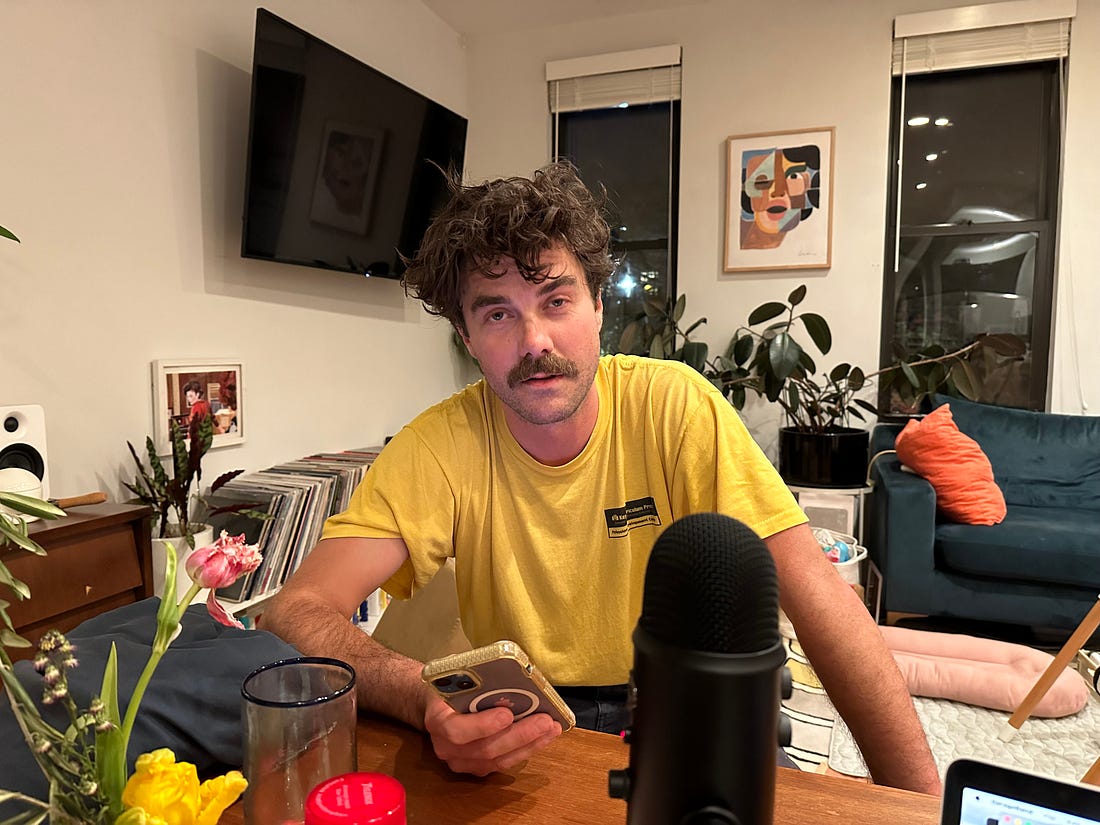
Danny (née Daniel) Nelson is the cohost of my monthly advice podcast, Dear Danny, and while our perspectives often overlap, our approaches tend to be wildly different. Sometimes I find him baffling, other times I’m knocked over by his insight (all part of his charm). Today I called upon him to answer question #2 because it suited the written column and the letter writer specifically asked for his perspective. I’m up first:
I think this question comes for all of us eventually. Beginning in kindergarten, when we’re asked to define ourselves via cartoonish dream job or by listing adjectives that begin with each of the letters in our names, the issue of who we are is presented like a multiple choice question for roughly the next 25 years. (I always picked “happy” for H, by the way, very quaint.) For a long time, the “who are you” riddle feels like the crux of growing up, as if it’s each of our destinies to solve it. When I was a teenager, figuring out who you were was basically synonymous with selecting the perfect song for your MySpace page. Personality was self-selection. What to wear, how to speak, what to like—for years I saw these as the biggest questions of my life. The disillusionment came in waves. When I graduated college and started encountering more people whose various qualities seemed to contradict each other—gym rat who loved junk food; intellectual who loved celebrity gossip—I remember feeling excited and impressed. This was maturity, I concluded. But even then, I was still caught up on the labels, assuming that self-actualization existed somewhere in their surprises and subversions, rather than in disregarding them altogether. My move to New York may have extended this fixation a bit; the city can be very tribalistic and seems to reward refining your “type.” At 26, I loved being “a writer.” At Man Repeller, we regularly pulled in page views by categorizing people: by style, by preference, by zodiac sign. It was the Buzzfeed content-as-mirror playbook. I know the type of self-definition you’re hinting at runs deeper than kindergarten posters and 2010s-era internet fluff, but I think it’s useful to draw a connection between those things and what you’re talking about. Categories and labels provide a certain buffer for the young and insecure. I don’t use the word insecure ungenerously either; youthfulness is necessarily insecure. That’s part of what makes it exciting and full of opportunity. Labels can bolster us during that period. But their usefulness pales over time: less grounding, more limiting. Labels come with social rules or unspoken guidelines, they inspire a relentless focus on how others see us in blunt terms. The pictures they offer of us can be almost offensively incomplete. Your question perfectly captures the limits of organizing our identities around specific ideas or actions, the limits of trying to organize our identities at all. If I’m passionate about learning French all my life but never do, can I still call myself a Francophone? I suppose not, but who cares? Am I filling out a survey about my follow-through on my death bed? Wanting to learn French all my life but never doing it is arguably as interesting as doing it. Are you a pianist? A lawyer? A marathon runner? If you know how to do those things, why not? Your focus on the semantics—the express label versus the varied narratives they represent—suggests you’re thinking of personality in terms of discrete categories a la social media hashtags or dating profiles. I don’t think these categories will help you understand yourself any better than those things help you understand others. What you call yourself is far less interesting than what you think and do and how you are. People will connect with the latter much faster, and more deeply. I think you’re right to assign some of this spiral to your pregnancy. Perhaps even more than the rocky decade of your twenties, parenthood challenges your very notions of identity. Not by making you into a different sort of person—although maybe that too—but by reorganizing your relationship to “who you are” in general. This happens over time, from early pregnancy through postpartum and beyond, as a slow parade of crises and consequent breakthroughs. Before I gave birth, I obsessively feared “losing myself” in motherhood and hoped I could somehow prevent it. Three years in, that perception of a kind of slippery “self” feels naive and a little silly. I’m less consumed by self-definition than I’ve ever been, and it’s freed up a lot of headspace. Some time last year, a friend of mine told me she was a bit offended on my behalf by the way some of our friends jokingly called me “mom” when I showed up at late drinks or dinners. As in, “Heeeyyyyy, Mom’s night out!” She (sweetly) felt they were boxing me in. But as much as I appreciated her protectiveness, I couldn’t connect with the offense. It helped that I no longer saw “mom” as derogatory or minimizing and then there was the fact that what they were saying was simply true. I was a mom! It was a big deal when I arrived at late drinks or dinners. My acceptance of these realities made it so their phrasing never caught my attention. Pre-kid-me might have exhaustively grappled with being “labeled” like this; now I couldn’t care less. You mentioned you find “self-definition” useful—part of what spurs me on to be a great friend, partner, and community member. I challenge you to find a new motivational framework (even just “values”) for how you show up for people. I think you’ll find it more useful, as far as navigation goes, to look inside yourself, at your most abstract and passionate stirrings, than to look outside yourself, at what you’re technically allowed to call yourself. Better yet, attend to questions about who you are by living them out, and forget about the answers altogether. And finally, a question for Danny and his advice:
Subscribe to Maybe Baby to unlock the rest.Become a paying subscriber of Maybe Baby to get access to this post and other subscriber-only content. A subscription gets you:
|




Comments
Post a Comment