#266: The Botox Psyop

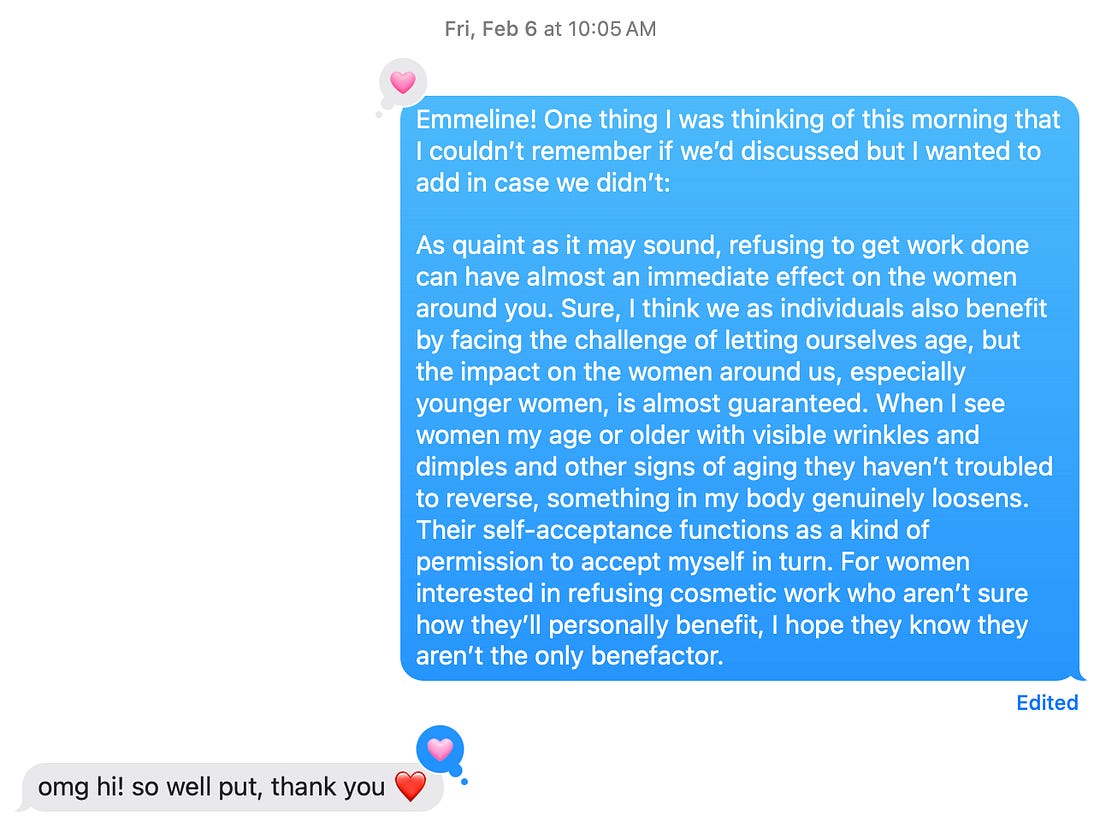
This is a free Sunday newsletter. If you love it, consider supporting it financially. For $6/mo, you’ll gain access to my Wednesday podcast (including my beloved advice podcast, Dear Danny), my Friday recommendations, and my monthly Q&A column, Dear Baby. You’ll also gain the ability to join (or spy on) my robust comment threads. To find something specific, head to the Maybe Baby Archive. (More links are at the bottom!) In early January, the author Emmeline Clein asked if I’d like to talk with her for a story she was working on for The Cut. It was “about Botox/‘anti-aging’ rhetoric with regards to feminism.” Last year, I’d read and loved her book Dead Weight, and since then we’d become friendly online. I also knew we were ideologically aligned regarding the beauty industry. “Was just reading your limits of destigmatization of cosmetic surgery essay,” she DM’d me after I posted about her book in March of 2025. “I’m trying to write something re: our demented moment’s relationship to plastic surgery.” I was flattered. “Please write a book about that!!” I replied. When she later reached out about the story for New York mag, I was wary of The Cut’s allegiance to traffic-driving headlines, but I like Emmeline and respect her work so much that it was ultimately an easy yes. My critiques of the piece as it was published are not aimed at her—anyone familiar with freelance writing knows that getting something published can be a delicate dance between what you want to say and what the publisher thinks “will work.” When we got on the phone a couple weeks later, she explained the article angle in more detail: As a 31-year-old woman living in New York, she was surrounded by Botox talk, and she wanted to interview some women who were older than her “whose lives she’d like to emulate” about their relationship with aging, Botox, and beauty. I was again flattered, and grateful she couldn’t see I was still in pajamas at 11am. We spoke for about 30 minutes, vehemently agreeing with each other the whole time. “Everyone” is not getting Botox, I told her, as the media likes to portray. Nearly all my friends, ranging from their early 30s to early 40s, had abstained so far. Most of us were cosmopolitan women who still like getting dressed and worked in or around media—ostensibly, we were part of the “everyone” cohort. My friends talked about cosmetic work in our group chats, but largely from a critical perspective: When we noted evidence of it on public figures we admired, we considered it a small betrayal, a grim sign. The only friends of mine who were truly grappling with their abstinence were those who worked as entertainers, who were constantly seeing their faces close up in high definition, and who often encountered professional peers who casually discussed tweaks like it was part of the work. Still, they’d held off. I told her I was entertained by witnessing my own aging process; that I thought it was healthy to understand myself as an evolving creature, with all the complications of that. I didn’t like the oft-wielded defense that cosmetic work enabled women to “keep looking like themselves,” as if physical signs of aging beyond our reproductive years threatened to disappear our identities. We talked a lot about the industry’s predatory nature, and the bleak future spelled out by a society that deemed this level of intervention “regular maintenance.” A couple weeks after our call, I texted her an additional thought about how abstaining from cosmetic work can be a form of solidarity with other women, and she was sweet about it.
When the piece came out last week, I was surprised by the title: “The Year All My Friends Got Botox.” As I read on, my surprise continued. In the first 2,000 words, Emmeline’s many interview subjects were all 33 or younger, and their needle-based cosmetic routines were relayed in detail. While her tone pointed to a dark undercurrent, often connecting these women’s pathologies to those with eating disorders—glimmers of the critiques I believe she holds—the overall packaging and shape of the piece painted a picture that’s become familiar in women’s media. Everyone was doing it, even the women who didn’t think they would. Especially them! This was, her anxious narration notwithstanding, quite different from her original pitch. In the end, 16 referenced or quoted women were Botox users (or seemed to be, or planned to be), compared with five women who were non-users and featured in less detail toward the end. I was completely fine with my own depiction, just surprised to be in the minority. Given what I know about how digital media works and what I know of Emmeline’s views on the industry, I immediately suspected The Cut had requested the piece’s reshaping. (Emmeline didn’t want to comment on the editorial process for this story, but supported my exploring it.) It’s a somewhat ironic reshaping too: from older women to younger; from critics to participants. An article that seemed, at the outset, interested in breaking down the narrative about “everyone getting it” ended up re-affirming it. It seemed no accident that this matched up with the rest of The Cut’s beauty coverage, which has become increasingly heavy on normalizing intense beauty regimens, some of which Emmeline cited in her own piece:
Beyond that, she employed many unnerving images and statistics to underscore the Botox¹ boom: descriptions of “tweely named” med spa chains (Ject, Peachy, and Plump) decorating all of lower Manhattan, where you can get injected “in the span of your lunch break”; frightening growth trends, like a “71% uptick in patients in their twenties.” The only absolute figure given was the number of injection sessions performed in 2024: nine million. These statistics all supported the new direction of the piece, but I found myself longing to read the story I’d signed up for, which Emmeline is so well-suited to write: Who wasn’t participating? This number is not readily available, but we can take a guess. The American Society of Plastic Surgeons specifies a slightly higher number of 2024 injection sessions than the piece: 9.9 million, so let’s round up to 10. If we conservatively estimate that only 30% of patients are regular users going 3-4 times a year (as practitioners recommend), 50% are dabblers going 1-2 times a year, and 20% are experimenters going once, this brings us to an average of two sessions per year per patient. If there were 10 million sessions, that’s roughly 5 million patients, over 4.7 million of which would be women (women received 94% of injections in 2024). That translates to 3.5% of adult women in America²—four percent if we’re being generous. If these numbers are in the ballpark, that means around 96% of adult women in America are not getting Botox. If the number of Botoxless women is much higher than you expected, we might ask why. Why does the media overwhelmingly focus on women who patronize the cosmetic industry or are otherwise preoccupied by it? As Emmeline wrote: “Even the women who avoid the injectable chair told me they were ‘terrified of aging,’ that certain friends who got work done looked, admittedly, fabulous, and owned up to uncertainty around whether their resistance might crumble in another decade or so.” I believe this is true of the women she was encouraged to interview, but if you, too, are a 20-to-40-something woman, I wonder if this level of paranoia feels true among your cohort, or if it just starts to seem true the more you hear that this is how everyone feels. “Women’s media”At what point is “women’s media,” even critical women’s media, incidentally acting as a marketing arm for the cosmetic alteration industry? To an extent, this is an occupational hazard: It is necessarily easier to report on something people are doing than something people aren’t. There’s also the conflict of publishers not wanting to alienate brands with deep advertising pockets, or alienate audiences who may disproportionately patronize the industry, which is an issue with beauty discourse I’ll touch on in a moment. And finally there’s the matter of editorial biases created by the women’s media freeconomy, which I’ve experienced first hand. When I was an editor at Man Repeller, I was offered more free beauty procedures than I previously knew existed. I was offered free Botox, free filler, free “non-surgical nose jobs.” I accepted free haircuts and scalp treatments, free facials and retinol serums and gua sha kits. Despite my burgeoning misgivings about the industry, I found it difficult to resist the level of easy access I was granted. No doubt this influenced our editorial output at Man Repeller, the swag we’d received showing up in our “skincare favorites” (even genuinely) and other beauty coverage. How many beauty editors at The Cut get free or “media discounted” injectables? Might this influence how they shape coverage critiquing the practice? Is it possible that well-meaning editors in a rarefied stratosphere of publishing and entertainment genuinely believe everyone is getting it because that’s the way it appears inside their bubble? “The Cut is a pro-plastic-surgery psyop now,” my friend said casually the other day, as if everyone knew this. She said it wryly but also with disappointment: At one point, we expected more scrutiny from them. Through this lens, the reshaping of Emmaline’s piece is unsurprising, and the criticism she managed to still convey is impressive. Our impression of what “everyone is doing” shapes our view of society at large, and by extension, our place in it. Emmeline described a feeling of being left out: “Friends’ casual mentions of Botox … provoked a familiar sensation: of missing a memo or being excluded from middle-school strategy sessions.” And later: “Cass, a 31-year-old friend, said that while she sees her Botox purchases as ‘a failure to enact the political convictions that I hold,’ that is ultimately ‘a pretty common experience if you’re living in the U.S. in 2026.’” Another said that while she opposed rationalizing Botox as feminist, “she wondered whether it’s really fair to make it ‘our personal responsibility to look fucked up so that we can uphold our values?’” These women are describing peer pressure. It’s no big surprise that social media algorithms favor the spectacle of before and afters, that Hollywood necessarily platforms the most cosmetically enhanced women on Earth, but if mainstream women’s media—no matter how supposedly critical certain titles would like to be—are constantly suggesting that women who don’t participate are a dying breed, that approaching mid-life is like “heading for a cliff,” it’s possible the myth of ubiquitous procedures will edge closer to reality. The repeated assertions are a form of soft coercion. My amusementFor the sake of sharing an alternative perspective, the reality of aging for me, rather than being “terrifying,” or even wonderful or liberating, is merely amusing. Reigning it in via cosmetic work is not something I wring my hands about. I simply choose not to consider it, and therefore never sweat it. I say this even as someone who’s paid a decent amount of attention to my face over the last year, during which my skin has seemingly aged more quickly than it did over the 15 years prior.
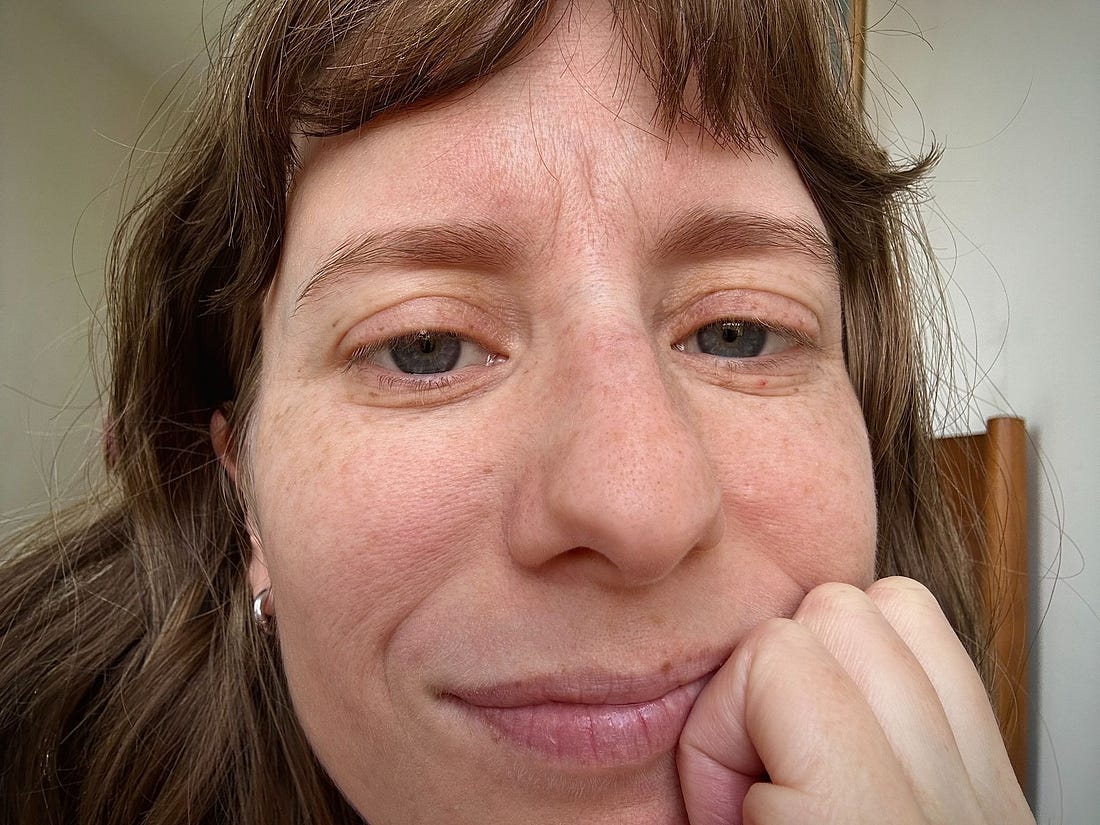
I do not necessarily appraise my wrinkles as “reminders of previous smiles and wisdom earned” (or whatever). Maybe sometimes. Other times I’m disappointed to find that physically aging has less often entailed “gaining wrinkles” than “looking vaguely hungover,” as if I’m constantly caught in fluorescent lighting. Still, it’s possible to find this entertaining, or at least interesting. Have you ever gotten a wrong-feeling haircut and found yourself a little fascinated, in a neutral sense, by your image in the mirror? Or how about the shocking moment of reaching the age your mother was when she gave birth to you and recognizing how much older you thought you’d feel? Aging can be like that: surprising, playfully disorienting, not an emergency or a punishment. Sometimes I even find it beautiful. There’s something useful about transitioning from appraising your face like a project, as I did more often when I was younger, to appraising it out of curiosity. The reward system breaks downs. If there’s little for me “to do” about my face, there’s little for me to gain by investing my time and energy into it, and so naturally my interest wanes and reroutes. This is one of aging’s many gifts. When we interrupt it by holding on to how things used to be, we miss out on things more worthy of our attention. I can’t speak for all my friends, but I don’t think I’m an outlier among them. Our collective crawl toward middle age doesn’t feel like preparing for obsolescence. We’re still discussing what we want and need to figure out, reveling in what we’ve earned, fantasizing about how exactly we’d like to grow old. We gossip with relief about what we’re no longer worried about. We make jokes about the early signs of our oncoming jowls, but the horror is more performed than truly experienced. We’re just bonding. It actually feels fine. The strawmanIt can be hard to share these experiences without being accused of moral one-upmanship. When one of the commenters under Emmeline’s piece shared that she found the Botox trend strange, that she thinks the women interviewed should examine their shame instead of rationalizing it, and that she herself has welcomed the lines on her aging face and looks forward to being treated like an older woman versus degraded as a younger one, the singular reply was: “How’s the view from way up there?” In a similar vein, another comment read: “I’m so tired of people wanting a gold medal for not getting cosmetic treatment. It’s giving major pick me energy.” Other comments complained that arguments against Botox were “stale,” that the piece was too long and exhausting, that the descriptions of frozen faces were inaccurate, because good doctors wouldn’t do that. A few people argued back, and the bickering devolved as it always does. Since those who support “giving in” and those who support abstaining are both in conversation with patriarchy—one group aims to survive or thrive within the system while the other aims to subvert it—it’s difficult to have a sober conversation about strategy without emotion taking over. This is when the moral scorekeeping kicks in. If patriarchy is oppressive and privilege is distributed unequally, no one should be shamed for being coerced into cosmetic work and no one should be celebrated for resisting said coercion. While I agree that shame isn’t useful and erodes solidarity further, when we over-emphasize the morality of individual choices and insist that critics be quiet to protect feelings, we miss an opportunity to denounce a predatory industry, explore the anxieties that power their profits, and acknowledge those who model divestment (or better yet, exhibit a laughing disinterest, like the women I most admire). More importantly, we may fail to recognize what is in fact already reality: Abstention from cosmetic work is actually the norm. The mirror worlds of social media and Hollywood and women’s media may present our participation as inevitable, but this is effectively an advertisement for a future that doesn’t have to exist. The overwhelming majority of women are not participating, which means it’s actually more accurate to describe cosmetic work as fringe. Even, as that one commenter put it, strange. When we’re led to believe, as women, that our participation is predestined, that abstinence requires great social sacrifice, we’re swayed to make it true. This is the ultimate irony, because in fact, when we abstain, we’re part of a much broader, less alienating, more liberating collective. I hope Emmeline writes the book.
Last Friday’s 15 things included the book I’m being annoying about, my TV revelation, mother’s latest interview, some literary media gossip, and more. The rec of the week was scrubs that aren’t scams. Wednesday’s discussion was about whether one Maybe Baby reader should have a baby with her best friend. Great advice! One again recommending Adam Johnson’s new book, How to Sell a Genocide, on “the media's complicity in the destruction of Gaza.” If you missed my annual Find-a-Friend post, people are still commenting. Take care!
1
Where I colloquially refer to Botox, I am also referring to Botox-like injectables of other brands.
2
Based on the 2024 U.S. Census Bureau population estimates and age/sex distributions, there are approximately 135 million adult women in the United States. You’re a free subscriber to Maybe Baby. For the full experience, become a paying subscriber. This quarter a portion of subscriber proceeds will be redistributed to Neighbors Helping Neighbors, a mutual aid fund for Minneapolis families affected by ICE raids. Leave feedback • Request a free sub • Ask Dear Baby • 802-404-BABY
|





Comments
Post a Comment