Why there is no ‘Cut for men’ (by a men’s magazine editor)

Why there is no ‘Cut for men’ (by a men’s magazine editor)Plus: Beehiiv vs. Substack, press event swag, and about that GQ Substack party quote...
Welcome to media_gossip, Embedded’s special weekly edition of … media gossip, sent every Friday. You’re getting this because you subscribe to Embedded, but you can opt out here. Swag I’ve Gotten At Press Events, Ranked
—Kate
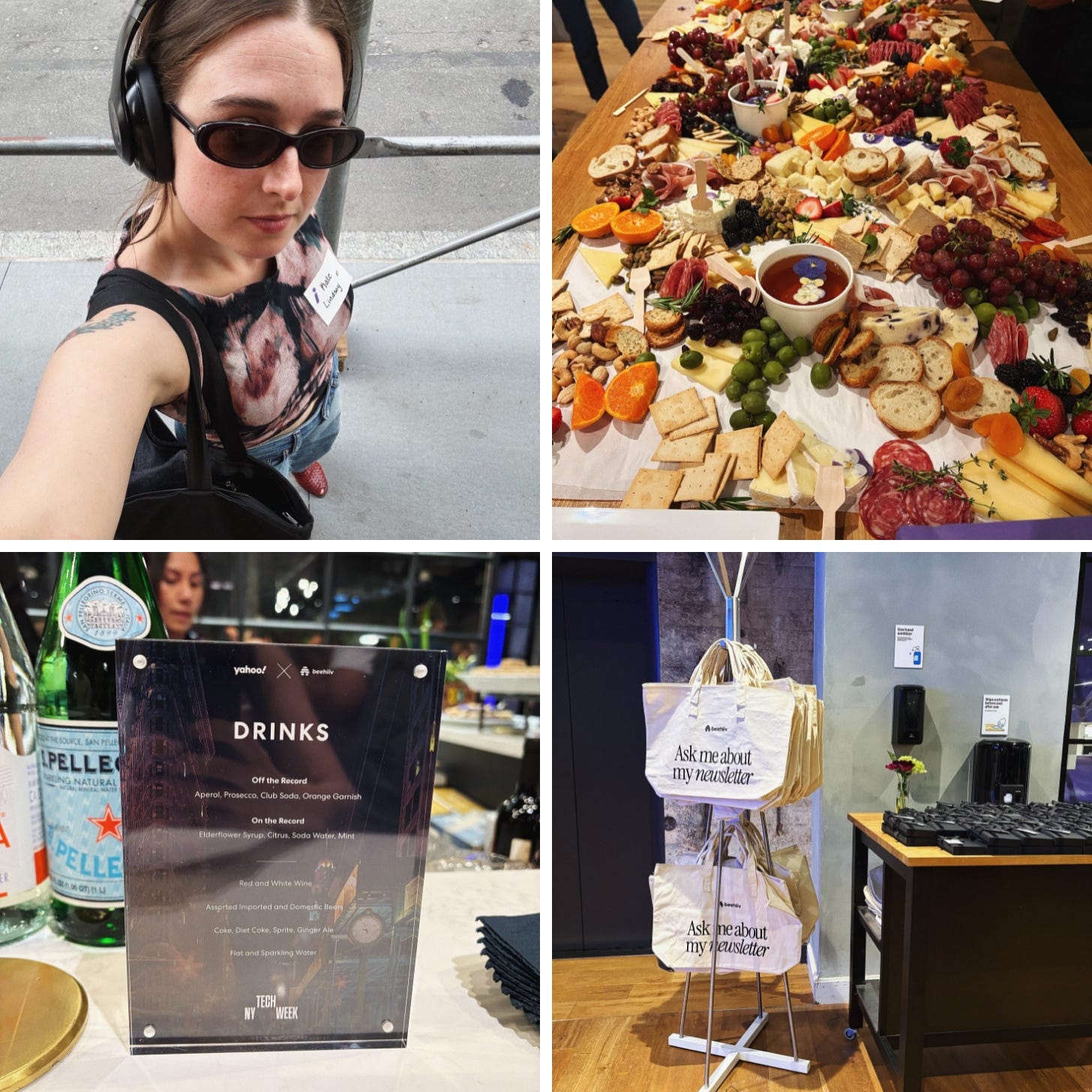
I had two "Off The Records," but didn't take a tote because I'm not about stolen valor.
I went undercover at the Yahoo x Beehiiv Tech Week happy hour (and by that I mean: accidentally came wearing my new Substack tote and had to hide it by a couch) where I talked to a bunch of people who cannot be tagged due to the aforementioned Beehiiv of it all. This included Adam Bumas and Ryan Broderick of Garbage Day (Ryan described Embedded to a colleague as “the Jezebel to Garbage Day’s Gawker”), as well as Greg Swan, with whom I swapped a number of thoughts on Beehiiv vs. Substack that we both agreed are best left off the record.
You can’t handle The Cut for menBy Nick CatucciForgive me for engaging three-month-old discourse, but I am only now—having just left my job as the editor of GQ.com—at liberty to address why “The Cut for men” doesn’t exist. The writer John McDermott alley-ooped a few days of quote retweets when he posted the following in late February:
There was a “wrong answers only” tenor to many of the responses (“YouTube Golf is the Cut for Men,” Jay Kang chirped), while others mourned Grantland and even AskMen.com. Ryan Broderick had a typically incisive response, tweeting that “The internet fractured men’s interests into so many disparate niches with virtually no overlap that a ‘The Cut for men’ would be impossible. Any serious mainstream outlet for men in the 2020s would be an incoherent collection of various hobby drama posts (which I would read tbh).” More recently, when Emily Sundberg asked the great Sam Hine—who just left GQ for New York magazine—“Are you making The Cut for Men? And do we need a The Cut for Men?” Sam answered that he would be focusing on men’s style coverage at New York, and that “I always felt that GQ was meeting that need.” The Cut conversation came up at GQ, at least in a couple meetings I was in, but more as a curiosity than an imperative to address. For what it’s worth, GQ’s new editor told The New York Times he wants the magazine to be a “North Star of masculinity,” which seems to suggest a shift away from the print magazine’s focus on fashion toward a more traditional men’s magazine approach. I will say that The Cut was a model for me, at least. Here are three touchstones as I described them in my pitch for the job in early 2023:
And I did invoke The Cut at my job, not only because it is very good, but because it focuses unapologetically on women and femmes, and I felt that we should talk to men and masculine people more than we talk about men. It was routine to hear pitches diagnosing the latest thing wrong with men, partly because, yes, there are many things wrong with men, but also because it’s easier to point those things out for an audience of other media workers than it is to genuinely engage with men who may or may not be drawn to unproven, uncool, or otherwise unsanctioned shit like peptides, jelqing, Claude, Hasan Piker, Sophie Rain, Billy Strings, Shane Gillis, Andrew Huberman, Graham Platner, Jordans, chore coats, Swatch collaborations, and A Knight of Seven Kingdoms. We covered many of those things in my time at GQ, and I mention them because those stories found an audience—specifically, I assume, among mostly straight men who are old enough to still read things, care deeply enough about those things to spend more time learning about them, and are underserved by other media outlets. Though that does leave out a whole other category of person who was reading what were among our most popular profiles: The ones with sexy original pictures of Connor Storrie and Hudson Williams, Taylor Zakhar Perez and Nicholas Galitzine, Morgan Spector and Carrie Coon, and Paul Anthony Kelly. Those readers were, I assume, largely gay men and women. It was important to me that we speak to gay men the same way we speak to straight men, and indeed, I believe gay men’s interests either overlap with straight men’s (in wellness especially) or, in culture, drive the same kind of niche passions that lend themselves to coverage. But there was one domain where we seemed to naturally serve gay men better than straight men: thirst... Continue reading this post for free in the Substack app
|







Comments
Post a Comment