Away just launched @actuallyaway

Away just launched @actuallyawayI talked to the luggage brand about why they are moving from posting to programming.
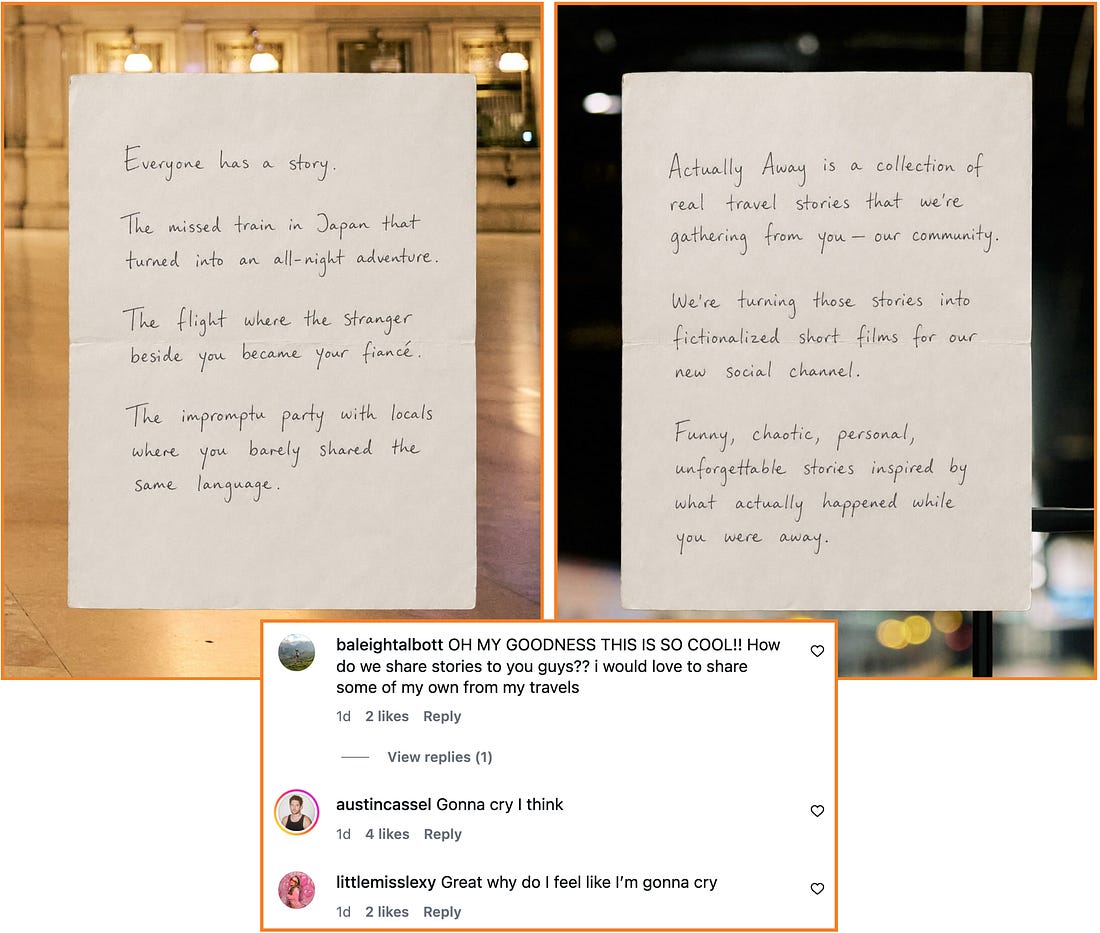
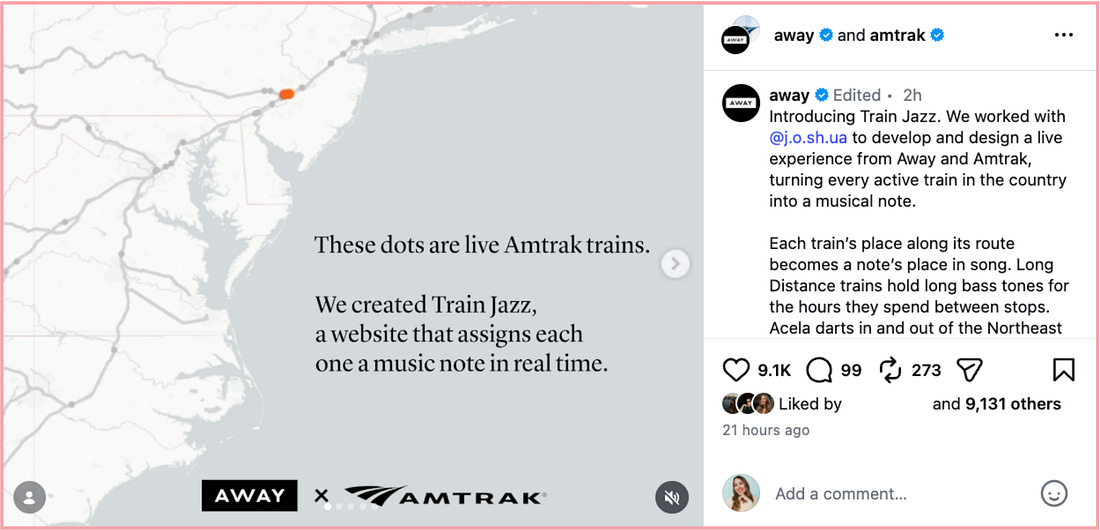
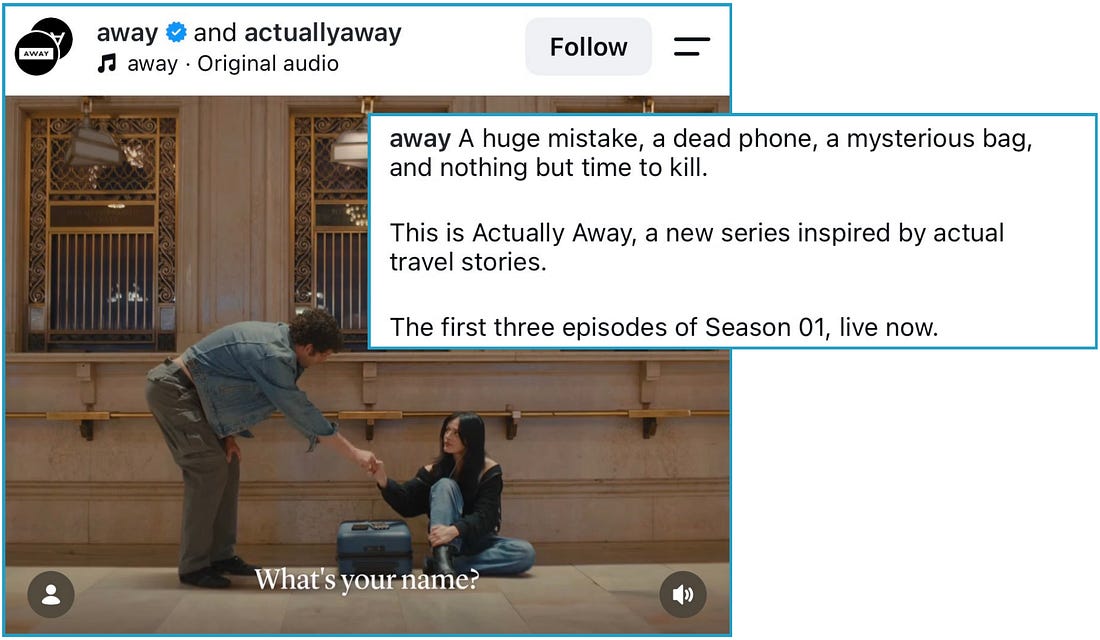
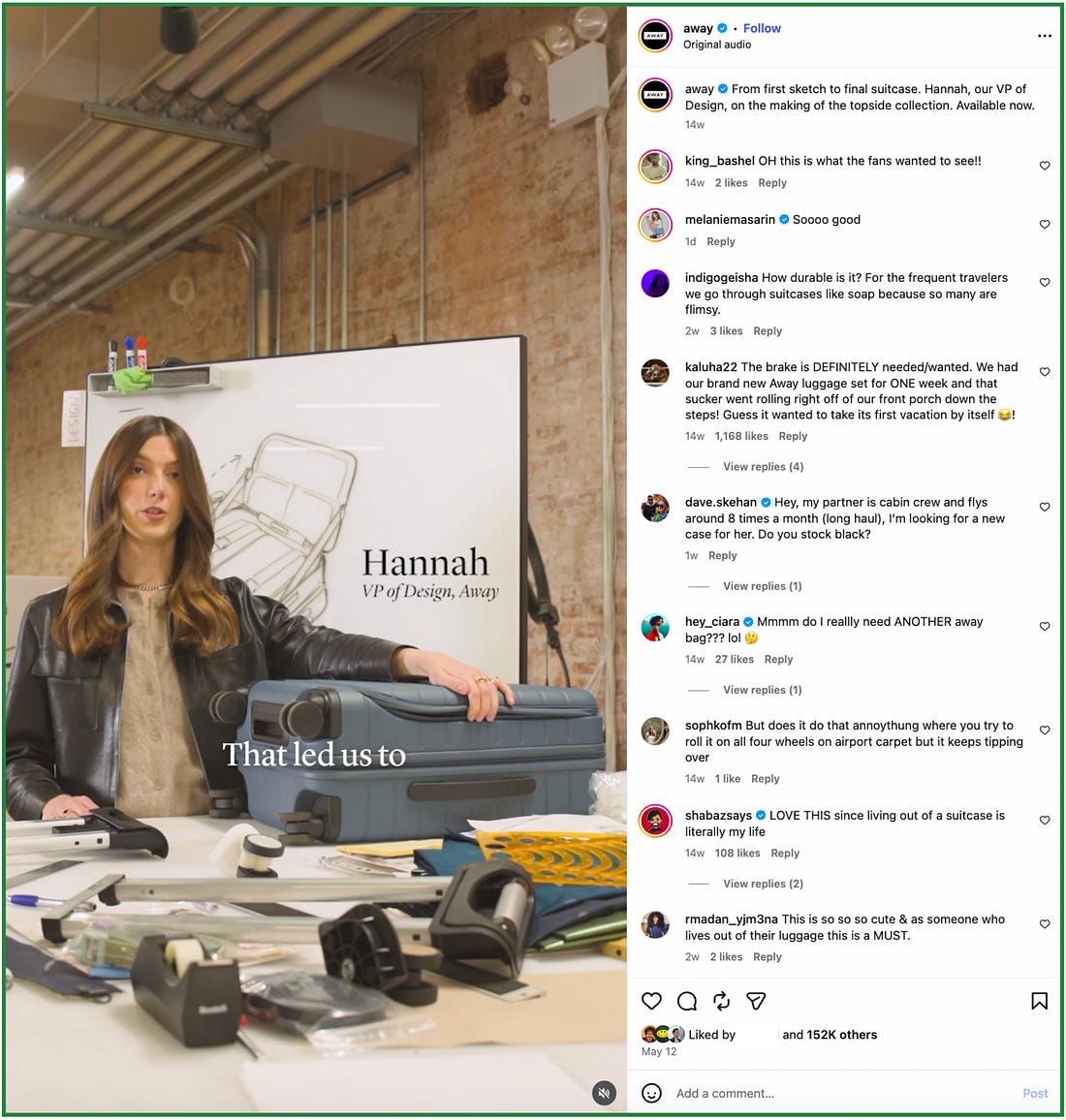
Hello! I hope everyone is having a wonderful day. If you want to make your day worse, we’re talking about all of those improperly disclosed Suno ads in the Link in Bio Discord. Join us! In my Tuesday newsletter, I wrote that while you do have to entertain on today’s algorithms, that entertainment should always be in service of brand. I think the incentives of the platforms have caused some accounts to take their eye off the ball. But when I think about companies that are sitting in the middle of that venn diagram of “brand building” and “entertaining”, the luggage brand Away comes to mind. Just look at their Topside campaign. They had their VP of design explain the technicalities of their new top-opening suitcase style while standing in front of a whiteboard. It felt like a very “your ordinary is your audience’s extraordinary” way into their design process. It garnered 3.4M views across platforms and, as you’ll find out below, sold 13 weeks of inventory in less than three weeks. One commenter referred to the VP of design in another video as their “new favorite influencer”. Since then, they’ve let tweens direct a campaign. Launched Amtrak Jazz, a website where they turned every active train in the country into a musical note. And, just a few days ago, announced @actuallyaway. The new account will feature short films inspired by actual travel stories gathered from their audience. It reminds me of The Ick, an account with over 600K followers that recreates dating stories, but for travel. You can watch the first episode here.
The strategy is led by Cayla DeRegis, who readers of this newsletter might remember from our conversation about NBA Research & Development. She has also spent time at places like Mischief and Buzzfeed. Below Cayla and I talk about why Away is moving from posting to programming, how they create engaging product education posts, and why it’s important to find inspiration outside of social media. ✏️ I just updated the Link in Bio Running List of Post Ideas. There are now over 170 evergreen formats inside. It’s a resource I always look at before big brainstorms. ✏️ Rachel Karten: First, how would you describe Away’s approach to social media? Cayla DeRegis: Our philosophy for social media is to create value before extracting value—we always aspire to serve the viewer first. We serve them in order to gain their attention, trust, participation, and eventual brand advocacy. We want to explore content and narratives that are entertaining or educational and invite people to come back and see what we do next. That philosophy also gives us a simple filter for what we put into the world: “Would we stop scrolling for this piece of content if we didn’t work at Away?” And just as importantly, are we excited to make it? We want to create work that we like and are proud of as a creative team, not simply content that fills a calendar. When we’re genuinely excited by an idea, there’s a much better chance that excitement will come through to our audience, too. With that, we’re shifting to more of a human-first storytelling lens, championing and celebrating our community of travelers. Rachel: What are some of the ways you’re doing that? Cayla: We’re thinking beyond individual posts and toward more participatory experiences. The internet asks people to watch; travel asks people to do. On social, we create content that invites our audiences to contribute, collaborate, experience, and help shape the story. Our Amtrak Jazz activation with Josh Wolk is a great example of that, as is this week’s launch of @actuallyaway, our new dedicated episodic social channel.
Rachel: I just saw the announcement post for @actuallyaway. Tell me more about it! Cayla: @actuallyaway takes that idea even further by putting our community at the center of the storytelling. The channel will be home to short films inspired by actual travel stories gathered from our audience, making the community’s experiences both the inspiration and the content itself. It’s an exciting evolution in how we’re approaching social: moving from posting to programming.
Rachel: One of my favorite recent campaigns from Away was for Topside. Can you tell me how the idea for these more technical whiteboard videos with Hannah, your VP of design, originated? Cayla: When I joined Away, one of the things that immediately piqued my interest was getting an inside look at how much thought and work goes into making our products. So when we were looking for ways to introduce our newest product, Topside, I knew I wanted to bring our process to the audience. Topside had been in development for a long time. Internally there is a lot of intention and attention paid to the travel problems we’re trying to solve, the iterations it took to get there, and why certain decisions are made. It felt like there was an opportunity to give people access to a part of the process they don’t normally see. Rachel: Can you share any of the success metrics? I’d imagine this video sold some suitcases… Cayla: We sold 13 weeks of stock in less than three weeks! The success of this style can’t solely be attributed to this one organic video, but the response to the content was huge. That video has more than 3.4M views across channels and is still the most viral post year-to-date. The collection is now back-in-stock, with other colors to debut soon. It also showed us that the format could keep working beyond that one launch. We’ve continued the series for other products, and those videos perform 95% above our average view baseline.
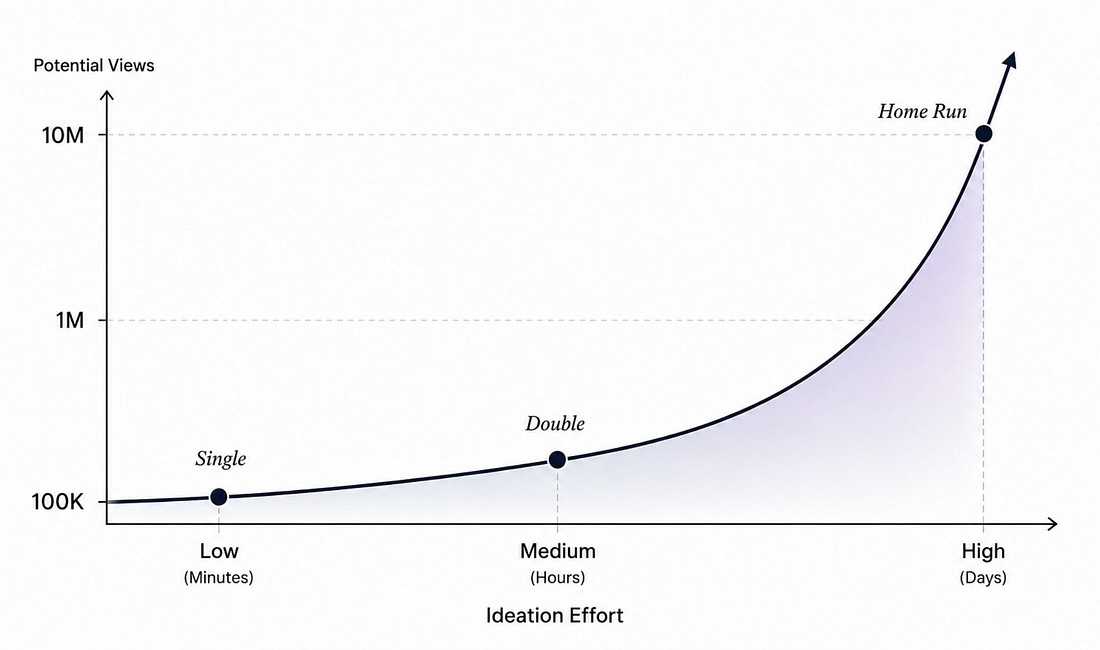
Rachel: Like you mentioned, Hannah has appeared in more videos since that campaign. Someone commented that she’s their favorite influencer. Why do you think this style of content is resonating? Cayla: People resonate more with people than they do with brands. A familiar face creates a sense of recognition and continuity. You’ll remember enjoying the first video you saw with Hannah, so when she shows up again in your feed, there’s already a connection there. It makes the content feel familiar, approachable and worth watching, rather than another piece of branded content. It also helps that Hannah is so effortlessly cool – on and off camera. Rachel: The hook in the Topside video is particularly great. “Designing a suitcase for people who like to live out of their luggage…” How do you approach coming up with engaging ways into videos? Cayla: Product education videos can very quickly feel like ads. We talk a lot about social being the new TV, but brands still tend to approach educational content like they’re making a commercial. TV has figured out a hundred ways to make learning entertaining through formats we already know and love—competition shows, process shows, game shows, reality shows. They take a structure people understand and apply it to a new subject. When we’re developing social content, I’m often thinking about whether there’s an entertainment format we can borrow from to make a brand or product story genuinely worth watching. This series is essentially our version of “How It’s Made”—giving people access to the process behind a product they might otherwise never consider. And then there are the hooks, which I obsess over. I’ll sometimes write and rewrite a hook 12 or 15 times before I land on it. A hook is visual, verbal, and written, and all three have to work together to create enough curiosity to make someone want to stay. Getting that right is genuinely an art, and probably one of the hardest parts of making content work on social. Rachel: I recently wrote about Trial Reels. Do you use them at all? Cayla: In the past, I’ve used Trial Reels to repost some of our top-performing content and see if it could reach a new audience, and I’ve also used it to A/B test different hooks so we can keep learning what resonates for different types of videos. There’s a lot of potential there, and it’s definitely a tool I want to put more structured experimentation around so we can get clearer about when and how it’s most useful. Rachel: Where do you find inspiration for the work you do in social media? Cayla: I am a big consumer of content, but I don’t actually spend that much time consuming content on social. I consume a lot of other mediums – TV, film, books, magazines, comedy shows, museums, performances. Those are often the things that inspire me the most. I think it’s easy to consume content on social and think, “Oh we can make a post exactly like this for our next launch.” vs. Looking outside of social gives you the space to think about storytelling and creativity in new ways, so you can bring something more unique to the platform rather than just adding noise. Rachel: What do you love about working in social media? Cayla: I feel so lucky that my job is to make things and share them with the world. I get to wake up every day and work with really cool creatives to tell unique stories and have fun doing it. That’s a very special career to have. What I’m scrollingChatGPT is citing Reddit far less than it did two weeks ago. According to analysis by Promptwatch, Reddit held a steady 3.8% share of ChatGPT Search citations. But on August 14 that share collapsed to under 1%. YouTube strategist Paddy Galloway, who has worked with brands like Red Bull and the Philadelphia Eagles, shared his YouTube playbook. I liked his home run ideation strategy. It basically says that you can make 10 “single base hits” (posts with an average amount of effort) or you can put the effort of those 10 videos into one video. Home runs that are attempted once a month or quarter. He says it’s a power law. “A much better idea and execution can hit exponentially more views.” It’s a good reminder for brands that are more focused on volume than quality. I also enjoyed listening to him on Colin and Samir here.
I love this video from Gap and Southern University Human Jukebox Marching Band. Speaking of, Walmart alum Justin Breton is joining Gap Inc. to drive original content. Variety reports that Justin will serve as Gap’s VP of development and will “drive original content across a range of genres and platforms to support the apparel giant’s ‘Fashiontainment’ business initiative.” Shout out to Emily Sundberg’s Feed Me for alerting me to this. A creator posted a eulogy to “background remover” because posts that use it are now being flagged as AI on Instagram. In a follow up post, Canva claimed this shouldn’t happen with tools like background remover. Mayor Zohran Mamdani got 2.8M likes and 35M views on a post announcing he’ll start wearing a helmet when riding a bike. According to Social Blade, the mayor’s account has added 868K followers in the past 30 days. Check out the Link in Bio Job Board
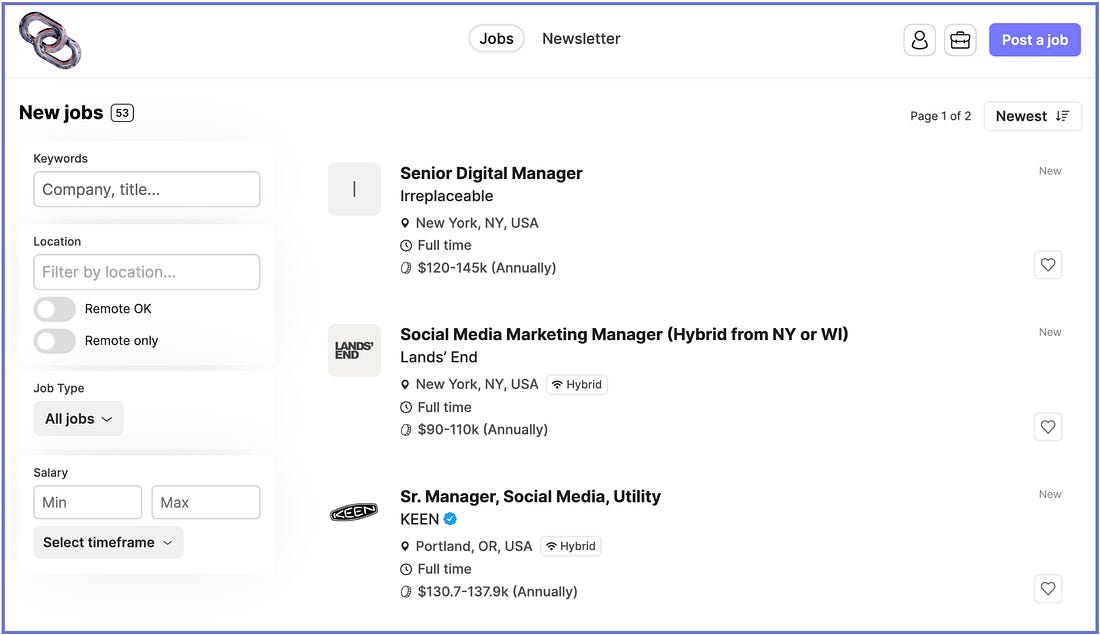
The Link in Bio Job Board features all of the best social media roles in one place, updated daily. Right now there are roles from places like Lovable, FIGS, Penguin Random House, and more. If you work for a brand that’s hiring within social media, this job board is for you too. Post your job listings to get in front of talented social media marketers. Thanks so much for reading. If you enjoy free interviews like this one, you can upgrade to a paid Link in Bio subscription. You’ll get weekly strategy newsletters and quarterly trend reports, along with access to the Discord community. I want to note that this newsletter is an educational resource and can likely be expensed through your company. I have even written a handy template for you to use when asking! If you’re already a paid subscriber, thank you for making Link in Bio possible! Interested in partnering with Link in Bio? Email rachelkartengroup@caa.com for more details. You’re currently a free subscriber to Link in Bio. For the full experience, upgrade your subscription.
|






Comments
Post a Comment